Is Baptism Necessary for Salvation?

Sunday’s Message:
As Pastor Ken is nearing the end of his series on Spreading the Good News (based out of Acts 8), he arrived at a passage that tends to be misunderstood, misinterpreted, and thus, misapplied.
Acts 8:36-38
36 And as they went on [their] way, they came unto a certain water: and the eunuch said, See, [here is] water; what doth hinder me to be baptized? 37 And Philip said, If thou believest with all thine heart, thou mayest. And he answered and said, I believe that Jesus Christ is the Son of God. 38 And he commanded the chariot to stand still: and they went down both into the water, both Philip and the eunuch; and he baptized him.
What about this passage is misunderstood, misinterpreted, and therefore, misapplied? The purpose of baptism.
There is a view within Christianity which teaches one must be baptized in order to be saved, become a child of God, receive eternal life, and/or be regenerated by the Holy Spirit. Known as “baptismal regeneration”, this is a view predominantly held within the Church of Christ denomination. And the passage PK preached yesterday is one of the proof texts used to teach this doctrine.
Is that what this passage teaches? And if not, what then is the importance of baptism? These, and more, were excellently explained by PK yesterday! Let us answer the first question, then conclude with answering the second.
Q: Does Acts 8:36-38 teach that baptism is required for salvation?
A: Absolutely not; for a few different reasons.
First, one of the principles of interpreting the Bible, is to understand that historical narratives (such as the book of Acts; books that mainly detail historical accounts) are “descriptive” rather than “prescriptive.” In other words, these books of the Bible are describing what happened and not prescribing what ought to happen. This principle is no different than reading true, American historical books; we don’t seek to determine what to do based off those historical accounts but rather seek to understand what happened in the past.
Now, we might be able to make some applications from past events to our present day & situation, but the main point of historical narratives isn’t to “prescribe” doctrine but rather to “describe” historical accounts. The book of Acts is no different; it’s describing what had happened, and from there, we might be able to draw points of application, but it doesn’t formulate doctrine (such as baptismal regeneration).
Secondly, when we consider the passage in the book of Acts, it’s interesting who asked the question about baptism; this is something PK insightfully revealed. Recall, Phillip was explaining to the eunuch about the Messiah whom he was reading about in Isaiah 53. One would imagine that if baptism was a necessary step for salvation, Phillip would proceed to tell the eunuch he needed to be baptized to be saved. But alas, we find that Phillip does not bring up the topic of baptism, but rather the eunuch does!
Acts 8:36
And as they went on [their] way, they came unto a certain water: and the eunuch said, See, [here is] water; what doth hinder me to be baptized?
So, why did the eunuch ask about baptism? Again, to this question, PK explained it convincingly! First, he reminded us that the eunuch was returning from Jerusalem, from where he was worshipping God.
Acts 8:27
And he arose and went: and, behold, a man of Ethiopia, an eunuch of great authority under Candace queen of the Ethiopians, who had the charge of all her treasure, and had come to Jerusalem for to worship
This seemingly insignificant detail, about the eunuch had gone to Jerusalem to worship, has a tremendous amount of influence in rightly understanding more about the man; and it requires a Jewish perspective to fully understand.
(We must not forget that much of the Bible was written by Jewish people, in a Jewish culture, and therefore, a Jewish perspective is crucial to understand biblical passages in their day, and then applying it into our day)
Within Judaism, there were three categories of Gentile believers: the God-fearer, the proselyte of the gate, and the full proselyte. Gentiles who believed in the Jewish God of the Old Testament (e.g., the God of the Bible; Jehovah/YHWH) and sought to worship Him, were considered God-fearers. Those Gentiles who believed in, and worshipped God, and followed the practices of Judaism, except for circumcision, were placed in the proselyte of the gate category. Finally, the ones who were considered a full proselyte were those Gentile believers who followed the practices of Judaism and went through circumcision (male-only requirement obviously).
Because we are told that the eunuch was returning from Jerusalem to worship God, he was considered, at the very least, a God fearer, according to Judaism. And as such, this Ethiopian eunuch would most likely be very familiar with the practices of Judaism; which would include the Jewish practice of baptism.
After PK had explained this, he continued to explain the Jewish practice and purpose of baptism.
The first Jewish perspective of baptism that PK mentioned was that when a God-fearer or proselyte of the gate desired to become a full proselyte, the individual would need to meet with the Beit Din (a council of Jewish rabbi’s who verify the honesty of one’s desire to join Judaism, and whether certain requirements were met), and once approved, the individual would become baptized. According to Judaism, this baptism becomes a public declaration of their leaving their former religious beliefs and aligning with the teachings & beliefs of Judaism.
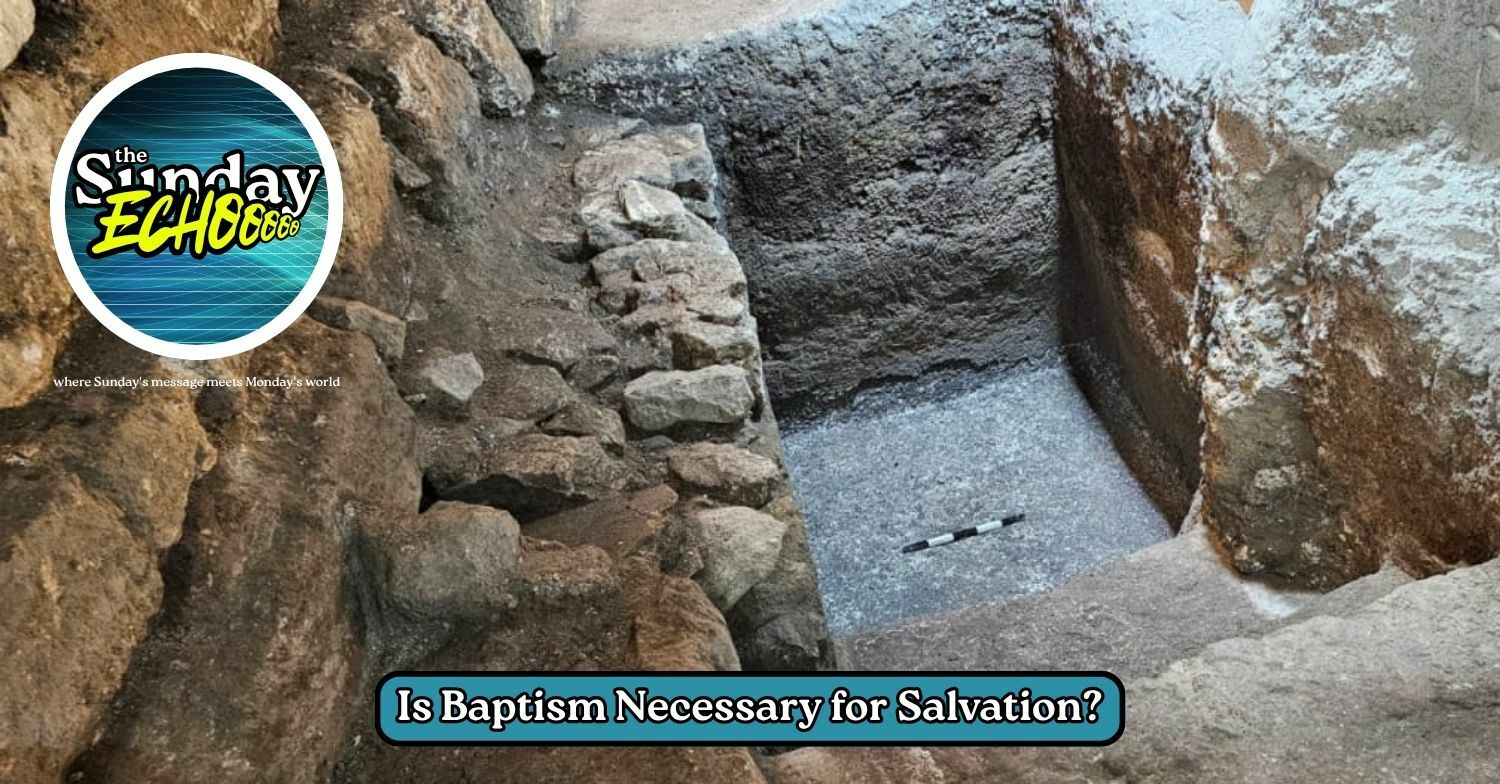
The second Jewish perspective of baptism was that it was performed by immersion, not sprinkling. In illustrating this ancient practice, PK showed a recent archaeological discovery of a mikveh in Israel. The “mikveh” is simply the Jewish term for what we would know of today as a baptistry. According to rabbinic sites, the waters of the mikveh was often no more than shoulder deep, and the Jewish requirement was that the individual being baptized would be fully immersed in the water.
Regarding the need for “immersion”, JoinJudaism.org (an organization dedicated to informing others how to join Judaism) states that it’s based upon Jewish tradition; or in other words, it traces its origins back to the Torah, as early as Exodus 30 & Leviticus 15.
So, from the recent mikveh discovery (and the many other mikvehs which have already been found in, and around, Jerusalem), to the Old Testament passages which speak of “bathing” by immersion, along with the New Testament Greek word “baptizo”, which literally means “to immerse”, all evidence points to the fact that a biblical baptism is one which is done by the means of immersion.
“If people would interpret the Bible from a Jewish perspective, they would not come to the conclusion that baptism was performed through sprinkling.” - Pastor Ken Stodola
Circling back to the Ethiopian eunuch, because we now understand he was a God-fearer, was familiar with the Jewish practice of baptism, and noticed a body of water which was deep enough for immersion, we can make sense as to why he asked Phillip about being baptized.
To the eunuch’s question, Phillip replied,
Acts 8:37a
37 And Philip said, If thou believest with all thine heart, thou mayest ...
In this verse, Phillip stated that the only requirement for someone to be baptized, is that they needed to have already believed in the Gospel message. And to this, the eunuch stated that he believes. Immediately then, the eunuch commanded his entourage to stop, and Phillip had the joy and privilege of baptizing him.
To wrap-up this first question (Does Acts 8:36-38 teach that baptism is required for salvation?), we see that:
- From a Jewish perspective, baptism was never through the sprinkling of water but was through the means of immersion.
- Baptism was never a salvific experience, but rather a public identification.
- Phillip told the eunuch he must believe the Gospel before being able to be baptized.
And when we remember one receives eternal life the moment they “believe” the Gospel message (cf. Acts 16:31; John 3:36, 6:40; Gal. 3:22; Eph. 1:13; 1 Tim. 1:16), there is nothing they can do to make them more saved; nor can any subsequent action complete the salvation process, because they have already been made a child of God.
PK had recommended the book “Faith Alone in 100 Verses”, by Dr. Robert Wilkin, for anyone who might be interested in studying how many passage speak about salvation being by faith alone.
Moving on to the second question.
Q: If baptism isn’t necessary for salvation, what is the importance of baptism?
A: This is an excellent question! As already mentioned, baptism is a public identification, and it’s a very important first step in one’s discipleship as a follower of Jesus; publicly identifying that they have believed in Jesus as their Savior. This public identification, through the means of immersion, also symbolizes the death, burial, and resurrection of Jesus Christ, as Paul penned in Romans 6:4. So through our public baptism, we identify with the death of our old self, and our rising to walk in the “newness of life” that Jesus had given us upon belief.
Sunday’s Echo:
Yesterday’s message was a great explanation for what constitutes biblical baptism, how the Jewish perspective sheds light on understanding baptism, and that while one’s eternal life is secured at the moment of faith, baptism is important to obediently follow Jesus Christ, publicly identify as a child of God, and to remember the great cost of our salvation.
|So, from this day forward, when we think about, hear of, or remember our own, baptism, may it be a reminder that we were bought with a tremendous price; and in remembrance, this should motivate us to walk faithfully & obediently in our new life, as we seek to bring glory to God, in appreciation for all that Jesus Christ has done.
(full sermon is linked below)

About
-
Open Door Baptist Church